Skip to content
Endorgobio

Demos

Three real decisions, solved live.

Each demo is the tool we built for an actual project. Change the parameters, solve again, and watch the recommendation change — nothing to install.

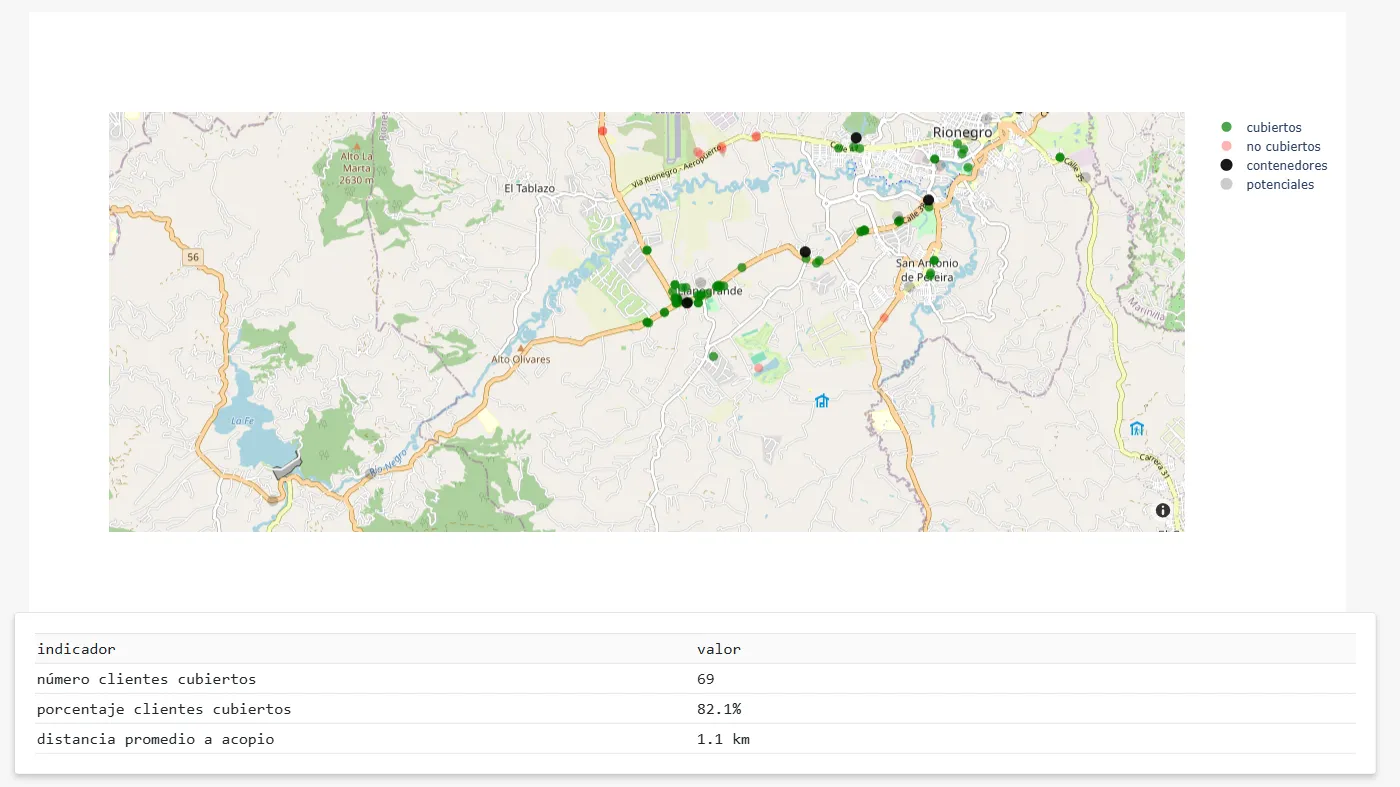
A map of eastern Antioquia with covered venues in green, uncovered ones in red and the selected bins in black, next to the coverage indicator table.

Circular economy

Federica Cork — cork collection network

The question

How many collection bins are needed, and where, so every partner bar and restaurant has one close enough to drop off its corks?

What the demo does

Federica Cork makes objects from cork recovered out of wine bottles, but that cork is scattered across dozens of venues. The demo lets you set the number of bins and the maximum acceptable distance: the map recalculates which partners are covered, which are not, and where each bin should go.

The result

5 bins cover 82.1% of partner venues, at an average distance of 1.1 km.

The demo interface is in Spanish.
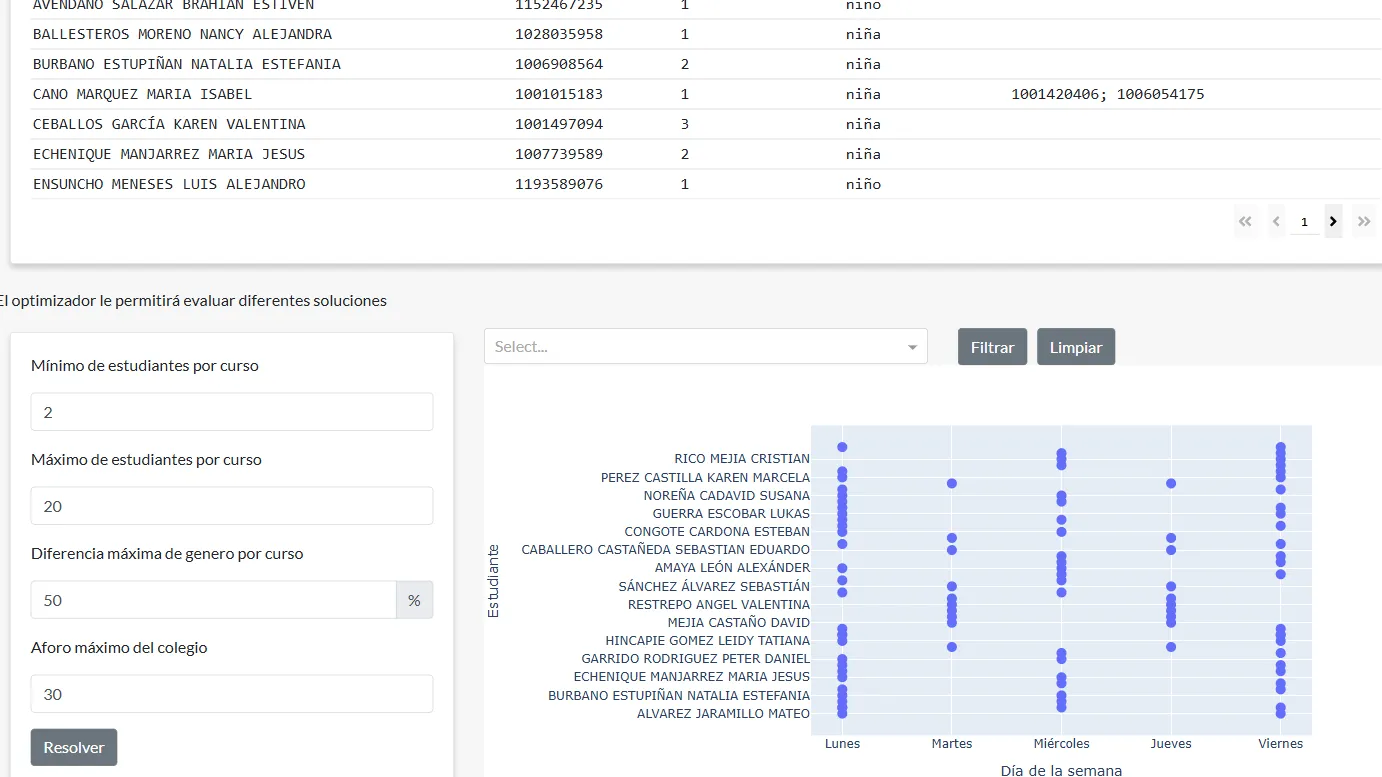
The demo panel with capacity and group-size parameters on the left, and on the right a chart of student against weekday showing the assigned attendance.

Education

Alternancia — rotating school timetable

The question

Which days does each student attend, within the school's capacity, the group sizes, the gender balance, and keeping siblings on the same pattern?

What the demo does

A school with 51 students across three preschool levels has to spread attendance over the week. Set the capacity, the group sizes and the gender-balance tolerance, and the model assigns each student an attendance pattern — Monday and Wednesday, Tuesday and Thursday, and so on — showing the resulting week.

The result

51 students assigned an attendance pattern without breaking a single constraint.

The names and ID numbers shown in the demo are fictitious. · The demo interface is in Spanish.

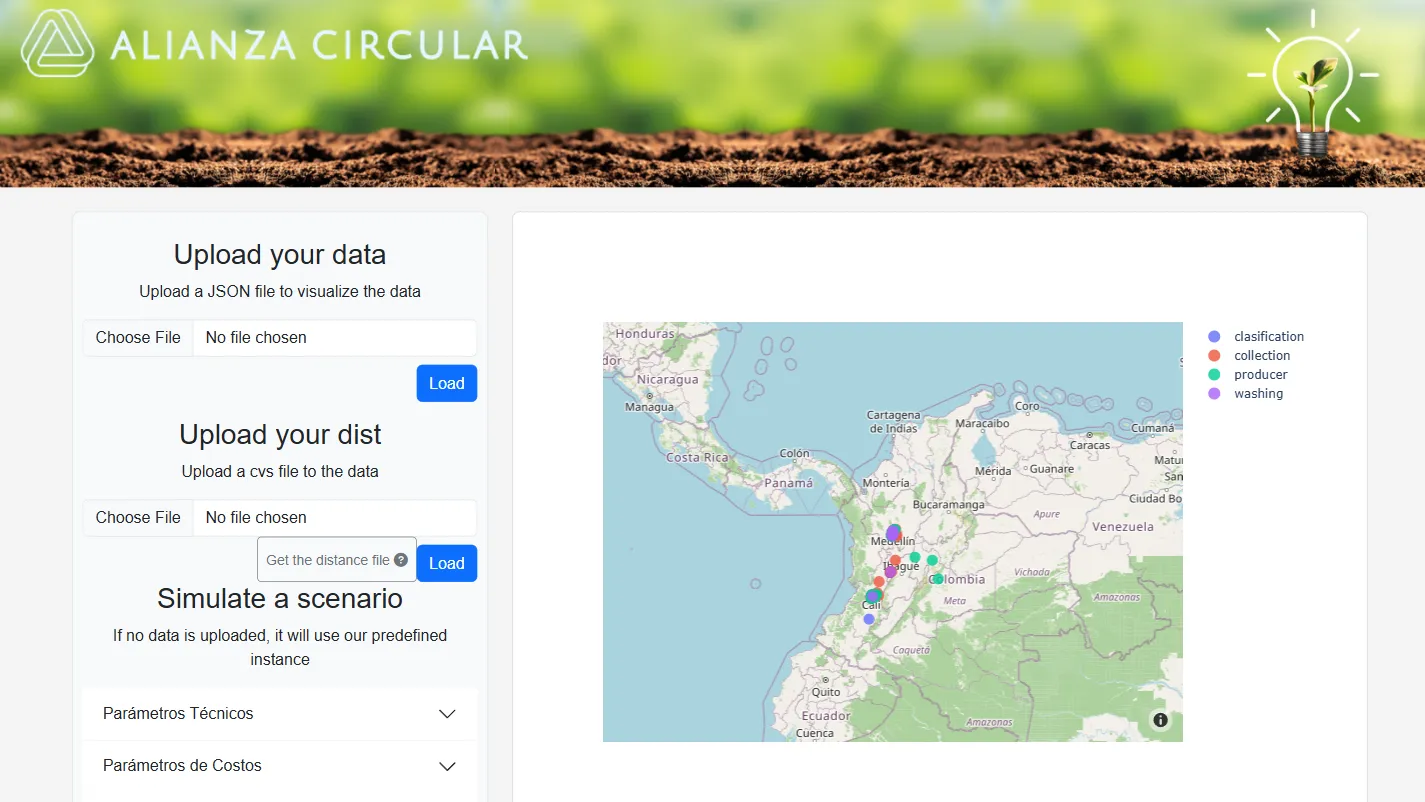
The simulator interface with the data-upload and parameter panels on the left, and on the right a map of Colombia showing the packaging network nodes.

Reverse logistics

Returnability — reusable packaging network

The question

Where should the washing and sorting plants sit, and how should reusable containers circulate, for the system to be financially viable and lower-emission than making new packaging?

What the demo does

The most ambitious of the three: it models the technical, cost, financial and environmental dimensions at once. Configure capacities, costs, environment conditions — WACC, inflation, demand growth — and emission factors, then simulate the scenario over a preloaded network. Your own data can be uploaded as JSON with a CSV distance matrix.

The result

Preloaded instance with 4 producers, 4 collection points, 1 sorting centre and 1 washing plant across Colombia.

Built by Endorgobio for the Alianza Circular project. · The demo interface mixes English and Spanish.

How they are built

Real models, on open-access tools.

These are not mock-ups. Federica Cork and Alternancia publish their full mathematical formulation — sets, variables, objective function and constraints — and solve the model against the case data. Doing that without buying software licences was one of the project's stated challenges.

Python + Pyomo
The model is written in code, keeping the instance separate from the formulation.
GLPK
An open-access solver under the GNU GPL — no commercial licence involved.
Dash + Plotly
The interface where the decision-maker explores the solution and tries other scenarios.
Case data
Geolocation, distance matrices and the parameters specific to each operation.

Does your operation look like any of these?

All three demos came out of real projects. If you recognise your problem in one of them, the next step is a conversation.